Working with me8 min read
How long does a brand identity project take?
Agencies quote eight to twelve weeks. I quote days. Both are telling the truth, and the difference is mostly about what happens between the design and the decisions.
Javeria Hareem
Logo & Brand Designer, founder of Jayy Studio
In this article
- The short version: a branding project timeline by scope
- A logo in 3 to 5 days, day by day
- A full identity in 7 to 10 days
- Packaging: about a week, more with variants
- Guidelines: a few days on top, or built in
- What slows a project down (it’s rarely the design)
- What I need from you on day one
- Why an agency quotes 8 to 12 weeks for the same scope
- Rush work, and what it costs
- After handoff: printing and rollout time
- Planning your own dates
- Questions founders ask me
The honest answer to “how long will my branding take” is: a few days of design and however long you take to decide.
That sounds flippant, but after a thousand projects it is the most accurate thing I can tell you. My part is predictable. A logo takes me 3 to 5 days, a full identity 7 to 10, packaging about a week. The part that varies is feedback, approvals and printers, and that’s the part nobody puts in the quote.
So here is a realistic branding project timeline for each scope, what happens on each day, what slows it down, and why an agency will quote you weeks for work that takes me days.
The short version: a branding project timeline by scope
| Scope | Design time | What’s included | Add for rollout |
|---|---|---|---|
| Logo | 3 to 5 days | Concepts, refinement, full file set, usage rules | A day or two to update profiles and templates |
| Logo plus brand basics | 5 to 7 days | Logo, palette, type, basic guidelines | A week to re-template the deck and social |
| Full brand identity | 7 to 10 days | Logo suite, colour, type, stationery, social templates, applications, guidelines | 2 to 4 weeks for print, signage and web |
| Packaging | About a week | Concepts, dieline artwork, panels, mockups | 1 to 3 weeks of printer lead time, longer with proofs |
| Guidelines only | 3 to 5 days | A 12 to 24 page guide around an existing brand | None; it’s a document |
Every one of these assumes the same thing: that when I send work, you look at it within a day or two and reply with one consolidated round of feedback. When that holds, the dates hold. The process post explains how I structure feedback so it does.
A logo in 3 to 5 days, day by day
Day one is Discovery. You fill in a short questionnaire about the business, the customers and the competitors you lose to, and we talk for half an hour. Nothing gets drawn. By the evening I have a written direction and I start sketching.
Days two and three are concepts. You see them in context, on a sign, a phone screen, a shirt, because a mark floating on white tells you nothing about how it will live. You pick a direction and tell me what’s working and what isn’t, in one message, not a drip of them.
Day four is refinement: spacing, weights, the standalone icon, the one-colour and reversed versions. Day five is handoff. You get AI, EPS, SVG, PDF, PNG and JPG files, organised and named, plus clear-space and minimum-size rules. If feedback came back fast, this often finishes on day four.
A full identity in 7 to 10 days
The first three days look the same: Discovery, direction, logo concepts. The difference is what happens once the mark is chosen. Days four to six build the system around it: the palette with HEX, RGB and CMYK values, the two typefaces and their fallbacks, the layout rules, the pattern or icon set if the brand needs one.
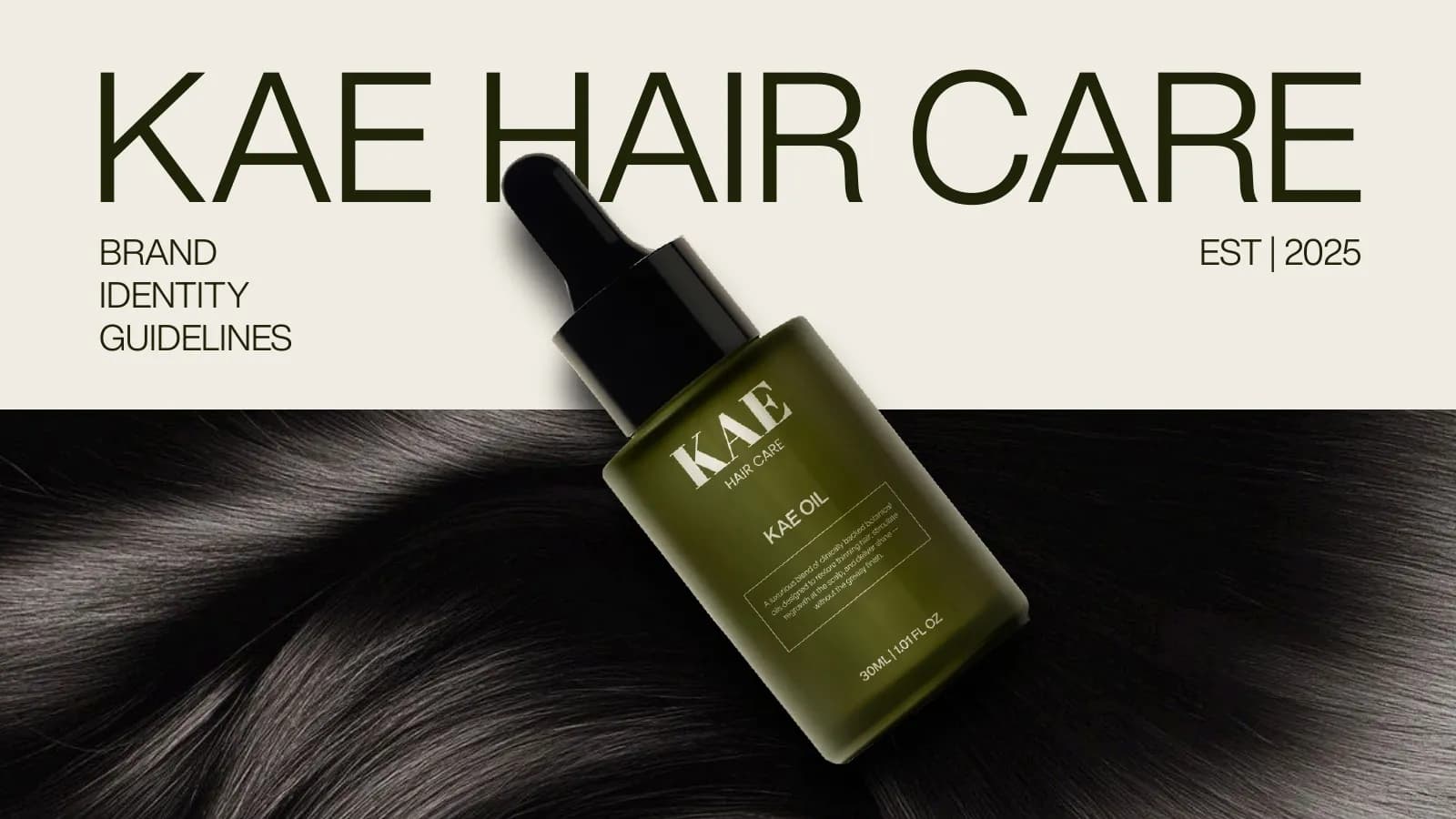
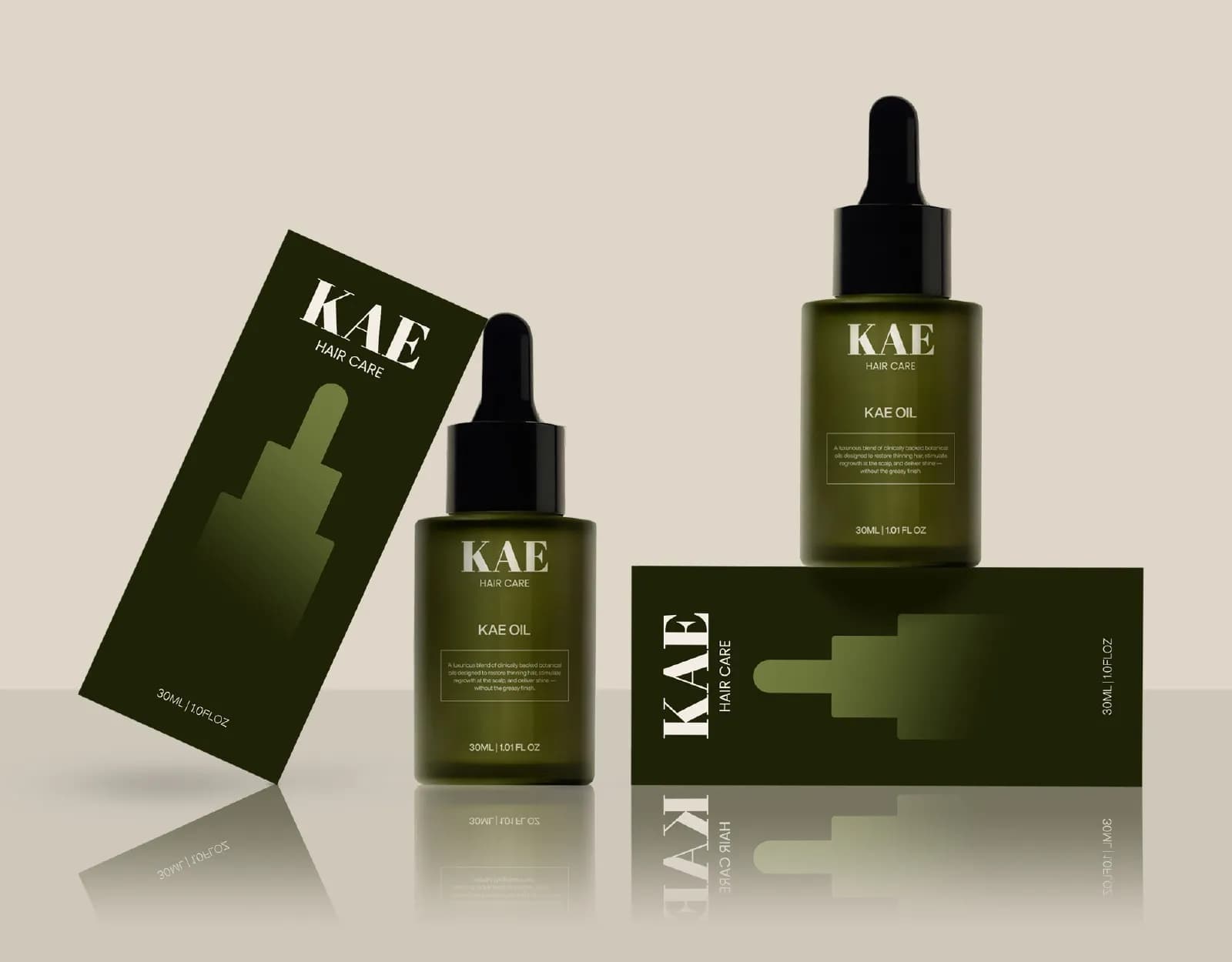
Days seven to nine are applications: business cards and stationery, social templates, the surfaces you listed in the brief, whether that’s packaging, signage or a deck master. Day ten is the guide and the handoff. KAE Hair Care is a good picture of this scope: logotype, monogram and icon, an olive and stone palette, serum bottle and carton, cards, bags and boxes, and a 17-page guide, all from one project.
Packaging: about a week, more with variants
Packaging has a dependency the other scopes don’t: the printer. Before I can design, I need the dieline for your exact box, bottle label or pouch, and I need it from the printer you’ll actually use. Chasing a dieline is the most common reason a packaging week turns into two.
With the dieline in hand, the week looks like this: concepts on the first two days, shown on the real pack shape, then artwork with nutrition, ingredient, barcode and legal panels set to spec, then mockups and a print-ready export. One product, one variant, about a week. A range of six flavours that share a layout, like the halawa line, adds a few days rather than six times the work, because the system is designed once and the colour changes.
If you’re going to print for the first time, read the packaging checklist before we start. It will save a round.
Guidelines: a few days on top, or built in
A guide for an identity I’ve designed is built in: I’m documenting decisions I already made. For an existing brand it’s a separate 3 to 5 day job, longer if I have to rebuild missing pieces first, like a vector logo that only exists as a JPG. Length depends on the team, not the brand: 12 pages served PuppyDock, 45 served Arista, because Arista has agents and suppliers who all need to follow it.
What slows a project down (it’s rarely the design)
In order of how often I see them: slow feedback, too many decision makers, missing content, and printers.
Slow feedback is simple maths. If I send concepts on Tuesday and hear back the following Tuesday, the project has gained a week and I’ve had to move on to something else in between. The fix is to block time for reviews before we start.
Too many decision makers is the one that quietly doubles timelines. Three people with opinions and no one with the final say means every round produces contradictory notes. I ask in the brief who signs off, and I mean it.
Missing content is the deck with no copy, the packaging with no ingredient list, the website template with no photography. I can design around placeholders for a while, but the final files need the real thing.
Printers are their own calendar. Proofs, approvals and lead times can add anything from a week to a month after my part is done, and nothing I do makes a press run faster.
What I need from you on day one
The questionnaire answered honestly. Every logo, colour and font file you currently have, even the ugly ones. A list of where the brand will actually be used. Photography, if it exists. A dieline, if it’s packaging. The name of the one person who signs off. And a date you actually need the files by, not a date you’ve padded to be safe, because the real one lets me plan properly.
The brief template covers all of this in ten questions. Clients who fill it in before the first call tend to finish earlier.
Why an agency quotes 8 to 12 weeks for the same scope
Because the agency timeline isn’t design time. It’s a research phase with a strategist, a creative director reviewing a designer’s work before you see it, an account manager scheduling the reviews, and a presentation deck for each round. Some of that adds value, particularly research, for a brand with multiple markets and many stakeholders. Most of it is coordination.
With me you talk to the person drawing. There is no internal review to wait for, no handoff between strategist and designer where things get lost. The same scope, the same file set, in days rather than weeks. Freelancer vs agency is fair about when the agency model is the better choice; timeline isn’t one of those times.
Rush work, and what it costs
I can compress most projects if I have to. A logo in two days is possible. A full identity in five is possible if you’re available for same-day feedback. Rush delivery costs extra, because it means moving other clients, and I’ll tell you on the first call whether your date is realistic or whether we should cut scope to hit it. What I won’t do is promise a date and then miss it; you’ll know the delivery day before you pay the deposit.
After handoff: printing and rollout time
Handoff is when my clock stops and yours starts. Business cards and stationery are usually a week with a local printer. Packaging is one to three weeks plus proofs. Signage depends on the fabricator and can be a month. Websites depend on your developer. Updating every profile, listing and template is a day if someone owns the task and a month if nobody does.
Plan backwards from the date the brand needs to be live, not from the date you want the design finished. If you need packaging on shelves in six weeks, the design has to be done in two.

Planning your own dates
Take the table above, add your realistic feedback time and your printer’s lead time, and you have a date. If it doesn’t fit, tell me the scope and the deadline and I’ll suggest what to cut or what to rush. If you’d rather hear it than read it, book a call; it takes thirty minutes and you’ll leave with a realistic timeline. The logo cost post covers the other half of the question.
Questions founders ask me
Sometimes, if the brief is clear and you can give feedback the same day. It’s rush work and priced as such, and I’ll tell you honestly if a day is too short for the mark you need.